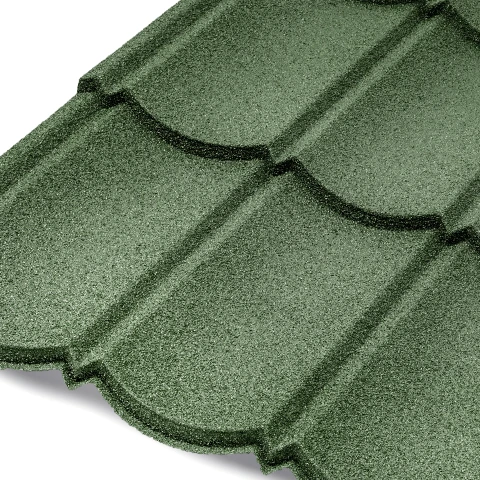
The service life and corrosion resistance of stone-coated metal roof tiles depend on the steel substrate as well as the natural stone granules, bonding system and manufacturing process. For roofing importers, distributors and project buyers, the coating mass of the aluminum-zinc coated steel is an important specification to verify.
1. What spangle size and brightness tell you
Al-Zn coated steel often has a silvery finish with a visible crystalline pattern known as spangle. In a hot-dip coating process, the aluminum-zinc alloy solidifies on the steel surface as it cools.
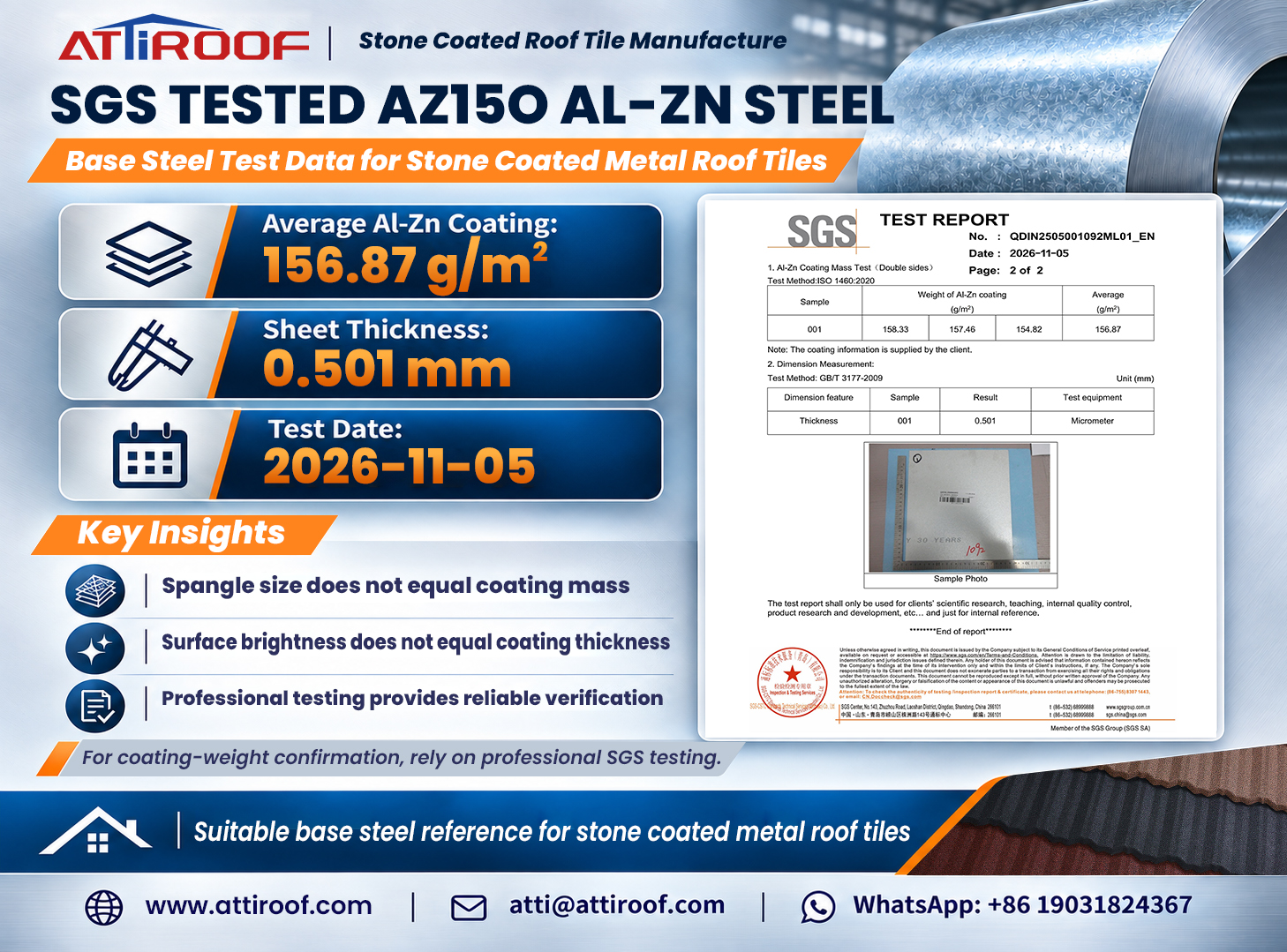
Alloy composition, cooling rate, crystal growth, substrate condition and finishing treatments such as passivation or oiling can affect the appearance. Two sheets specified as AZ150 can therefore have different spangle sizes or levels of gloss. Spangle size and brightness are visual characteristics and cannot establish coating mass or thickness.
2. What surface texture can tell you during inspection
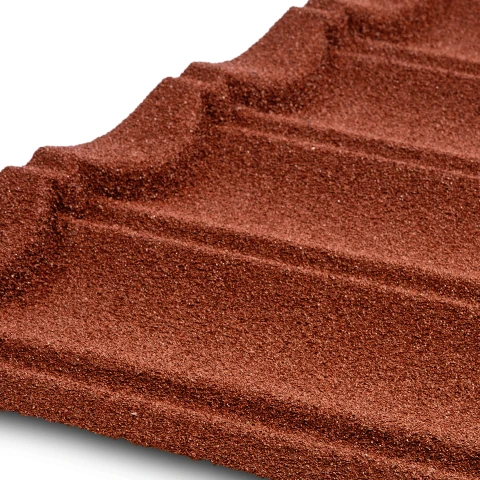
When comparing bare samples from the same mill, production process and surface treatment, inspectors may notice differences in texture. Some heavier-coated samples can feel more textured, while others feel smoother. Spangle, surface treatments and oiling can all affect roughness, so texture alone cannot establish an AZ grade.
- Compare bare samples from the same mill and product series with matching surface treatments.
- Use a reference sample with a documented coating mass.
- Use a clean glove to compare surface texture and uniformity.
- If you notice a significant difference, check it by quantitative testing.
3. How to verify coating mass with laboratory testing
A qualified third-party laboratory such as SGS can test representative samples against the specification agreed with your supplier. Confirm the sample type, test method, sampling plan and scope with the laboratory before submitting samples.
Coating mass
Coating mass is the mass of the metallic coating per unit area, expressed in g/m². Under EN 10346:2015, AZ100, AZ150 and AZ185 designate minimum combined coating masses of 100, 150 and 185 g/m², respectively, across both faces in the triple-spot test. Separate minimums apply to the single-spot test.
Coating composition
A typical 55% aluminum-zinc coating has a nominal composition by mass of 55% aluminum, 43.4% zinc and 1.6% silicon. The AZ150 designation covers the combined aluminum-zinc alloy coating. Elemental zinc is only one component of that coating.
Coating thickness
If a purchase specification calls for thickness, agree on a suitable measurement method and whether the requirement applies per side. ASTM A90/A90M covers gravimetric coating mass testing for applicable zinc and zinc-alloy coatings. ASTM A754/A754M covers coating mass measurement by X-ray fluorescence. Use the edition and method specified for the order.
4. How to estimate Al-Zn coating thickness from coating mass
Estimated thickness per face
Assuming the metallic coating is evenly divided between the two faces and has a density of approximately 3.8 g/cm³, use this conversion:
Estimated thickness per face (µm) = measured total coating mass (g/m²) ÷ [2 × coating density (g/cm³)].
At 150 g/m², the calculation is 150 ÷ 7.6, or about 19.7 µm per face.
| Total coating mass |
Estimated thickness per face |
Estimated combined thickness |
| 40 g/m² |
5.3 µm |
10.5 µm |
| 60 g/m² |
7.9 µm |
15.8 µm |
| 80 g/m² |
10.5 µm |
21.1 µm |
| 100 g/m² |
13.2 µm |
26.3 µm |
| 150 g/m² |
19.7 µm |
39.5 µm |
| 185 g/m² |
24.3 µm |
48.7 µm |
The table gives theoretical conversions at 3.8 g/cm³. The 40, 60 and 80 g/m² values are included for comparison. Actual coating thickness and its distribution may vary.
Estimated total coated steel thickness
Coated steel thickness = base steel thickness + combined thickness of the metallic coating. For a 0.40 mm base steel sheet with 150 g/m² of combined coating mass, the metallic coating adds approximately 39.47 µm (0.03947 mm), giving a theoretical total of 0.4395 mm. Actual readings depend on base steel tolerances and coating distribution. Paint, adhesive and other finishes add their own thickness.
Estimated zinc mass
Estimated zinc mass per unit area = alloy coating mass × zinc mass fraction. If the total measured coating mass is exactly 150 g/m² and the zinc fraction is 43.4%, the estimated zinc mass is 65.1 g/m². Confirm actual elemental content through composition testing.
5. Why coating mass matters for stone-coated metal roof tiles
The steel substrate provides strength and the Al-Zn alloy coating forms part of the corrosion protection system. When assessing the finished tile, consider the steel grade and thickness, coating uniformity, forming quality, bonding system, stone granule adhesion and service environment alongside coating mass.
6. What to check on a supplier’s test report
Use appearance and texture for incoming visual inspection. To verify an AZ requirement, ask for a traceable report that identifies the batch or sample, the test standard and method, and the coating mass results. Compare those results with the agreed triple-spot and single-spot requirements as applicable.
About ATTiROOF
ATTiROOF supplies stone-coated metal roof tiles and other roofing materials to importers, distributors, wholesalers and roofing contractors worldwide. Contact our team for specifications, bulk orders and OEM/ODM options.
Website www.attiroof.com
Email [email protected]
WhatsApp +86 19031824367
Technical references